Malaysia finance firms see AI ambitions falter as legacy systems block progress
Finance executives say technology should support decisions, not fully replace human roles
Malaysia’s financial institutions are accelerating investments in artificial intelligence (AI) and digital capabilities, but industry leaders warn that weak operational foundations—not lack of technology—are the real barrier to transformation.
Tok Puan Datin Ezreen Eliza, head, Transaction Banking - Securities Services, CIMB Bank Berhad and Chief Executive Officer, CIMB Trustee said Malaysia is making “very good progress” in digitalisation, citing movement into digital assets and tokenised instruments.
But she also said the industry needs “additional funds to actually enhance our technology,” adding, “We need more money. We need more support from the board, as well as our government as well, so that we can actually evolve to the next level.”
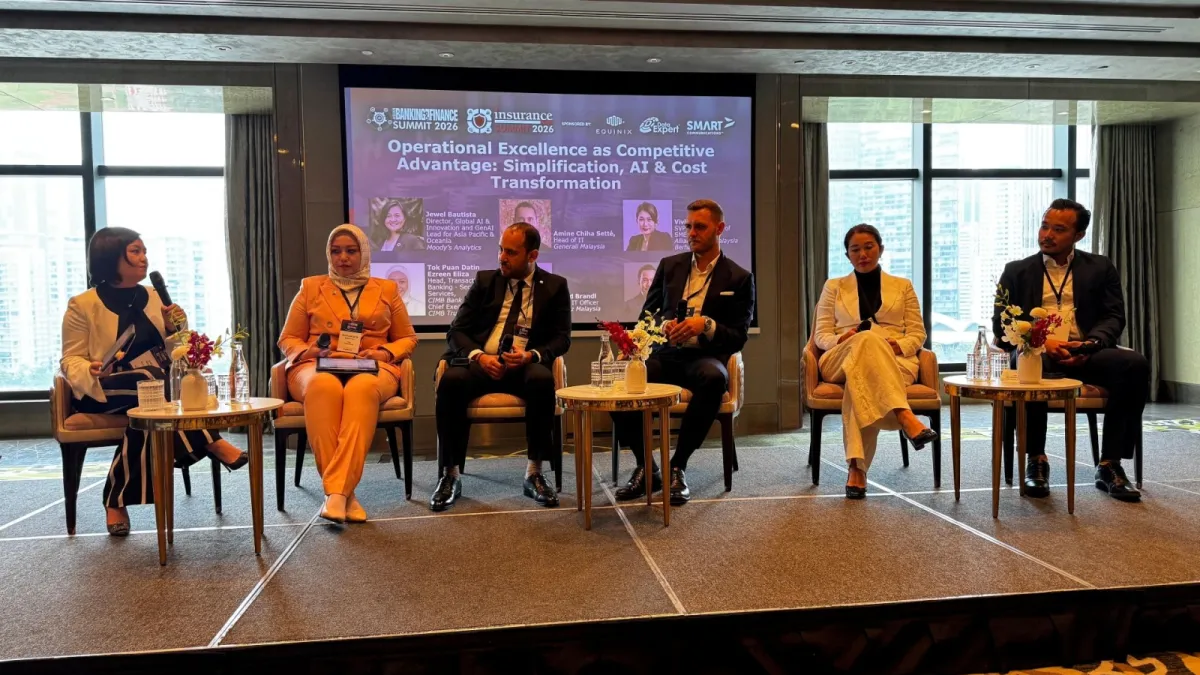
Panelists said at the Asian Banking & Finance x Insurance Asia Summit in Malaysia today that banks and insurers need to simplify processes first, fix data quality, strengthen governance, and apply AI to specific operational pain points rather than treat it as a shortcut to full automation.
Panel moderator, Jewel Bautista, Director, Global AI & Innovation and GenAI Lead for Asia Pacific & Oceania at Moody’s Analytics, set the tone by saying the issue is not simply whether firms adopt AI, but whether they can “build institutions that can be faster, more resilient, and frankly, it’s going to be more useful to our customers.”
David Brandl, Chief IT Officer of Allianz Malaysia, said operational teams are often too busy dealing with daily demands to rethink the process itself.
Using an analogy, he described “a person, like, 200 years back” pulling a cart with square wheels, and when offered a better solution, the person says, “Sorry, I don’t have time for your ideas.”
Brandl said Allianz Malaysia has tried to address this by making simplification and productivity part of its strategic agenda, with teams reviewing products, processes, and systems to determine “what we have to change, what we don’t touch, and what we basically can get rid of.”
He added that simplification should not be pursued only to save money, but to improve service and product delivery.
This was echoed by Ezreen Eliza, who said financial institutions in Malaysia must work through more than just operational issues when introducing new tools.
In custody and trustee services, she noted, firms answer to multiple regulators.
“We have two sets of regulators,” she said, referring to the Securities Commission and Bank Negara Malaysia. “On top of whatever the SC have imposed on trustee company, I also have to ensure that we are compliant to the bank.” That makes process redesign more complex, particularly when new technology touches regulated workflows.
Vivien Tan, SVP, group head of SME Credit at Alliance Bank Malaysia Berhad, said the banking industry may already have AI targets built into annual plans, but applying the technology in SME banking is much harder than it appears.
“AI is very good with structural information,” she said, but “when it comes to seasonal information, or call it SME information, it’s that is the most difficult part.”
Tan pointed to non-standard terminology in SME data and warned that “garbage in, garbage out” still applies.
“Can AI do everything for now? My answer is no,” she said. “The non-structured information, you will still need humans to decide for now.”
That caution was reinforced by Ezreen Eliza’s account of a discussion inside CIMB on whether AI could speed up KYC and account opening.
She said she had asked whether an internal AI tool could do the work of three staff and shorten turnaround times.
The answer she received was no. “You can’t actually expect AI to do that,” she said. “What they can do is they can actually create a system logic within our system, the existing system, and to actually, you know, come up with exception, to actually help to simplify the process, but not entirely removing the people.”
The discussion on cost transformation was also more measured than the usual industry narrative.
Gerard Ang, country head, Financing & Securities Services, Standard Chartered Bank Malaysia Berhad Trustee Berhad, said that the industry should stop thinking only in terms of cutting cost whilst holding revenue constant.
“A lot of people look at costs thinking that their revenues will continue to stay the same,” he said. “What if you maintain your cost, increase your values?”
He said that some technology spending, including in digital assets, should be viewed as long-term investment in future business models rather than near-term expense.
On the sector outlook, the panel was generally positive on Malaysia, though not without qualification.
Tan, however, was more direct about the state of readiness. She said even larger banks still struggle with old infrastructure.
“The legacy systems is actually problem,” she said. “It’s really painful to actually go through that kind of transformation and use that kind of money.”
She added that AI tools are likely to become cheaper over time, even if banks first need to invest in cleaning up their data.

















 Read Here
 Advertise
 Sign Up