
Singapore banks stretch hiring as caution deepens
Headcount across 15 lenders rose just 0.005% in 2025.
Senior banking roles in Singapore are now going through as many as nine interview rounds as lenders slow hiring decisions, tighten budgets and extend approval chains amid near-flat workforce growth across the sector.
Banks are becoming more selective in hiring even as demand remains concentrated in artificial intelligence (AI), governance, and hybrid banking roles that combine financial expertise with technology skills, recruiters said.
Fifteen of Singapore’s biggest banks employed a combined 56,378 people in 2025, up just 0.005% from a year earlier, according to data compiled by Asian Banking & Finance, underscoring a labour market that is effectively frozen in size despite continued recruitment activity.
“The hiring processes are slowing down,” Madiha Ridza, senior consultant for financial services at Robert Walters Singapore Pte. Ltd., said via Google Meet. “Approvals are taking longer and stakeholders are becoming more measured in their hiring decisions amidst this geopolitical uncertainty.”
Ridza said banks are no longer making hiring decisions within isolated business units. Instead, approvals increasingly involve cross-functional reviews across risk, compliance, and finance teams, extending timelines even when headcount budgets exist.
Recruiters said hiring is taking longer rather than stopping, with more interview rounds added at each stage, including technical checks, behavioural tests, and final approvals.
Michael Nette, senior managing director for Singapore and India at Ambition Group Singapore Pte. Ltd., said even contract hiring has become significantly more complex.
Contract positions used to only have one interview at most, but could now take two or three rounds, he said in a Microsoft Teams call. “For permanent positions, it used to be one to two rounds, now it could be four, five, six rounds. We have seen some eight, nine rounds for senior positions.”
He said senior hires are now often assessed not only on technical banking expertise but also on their ability to work across regulatory, data, and technology functions, which adds more layers of evaluation.
Tighter hiring processes come even as overall employment levels remain stable across Singapore’s banking sector.
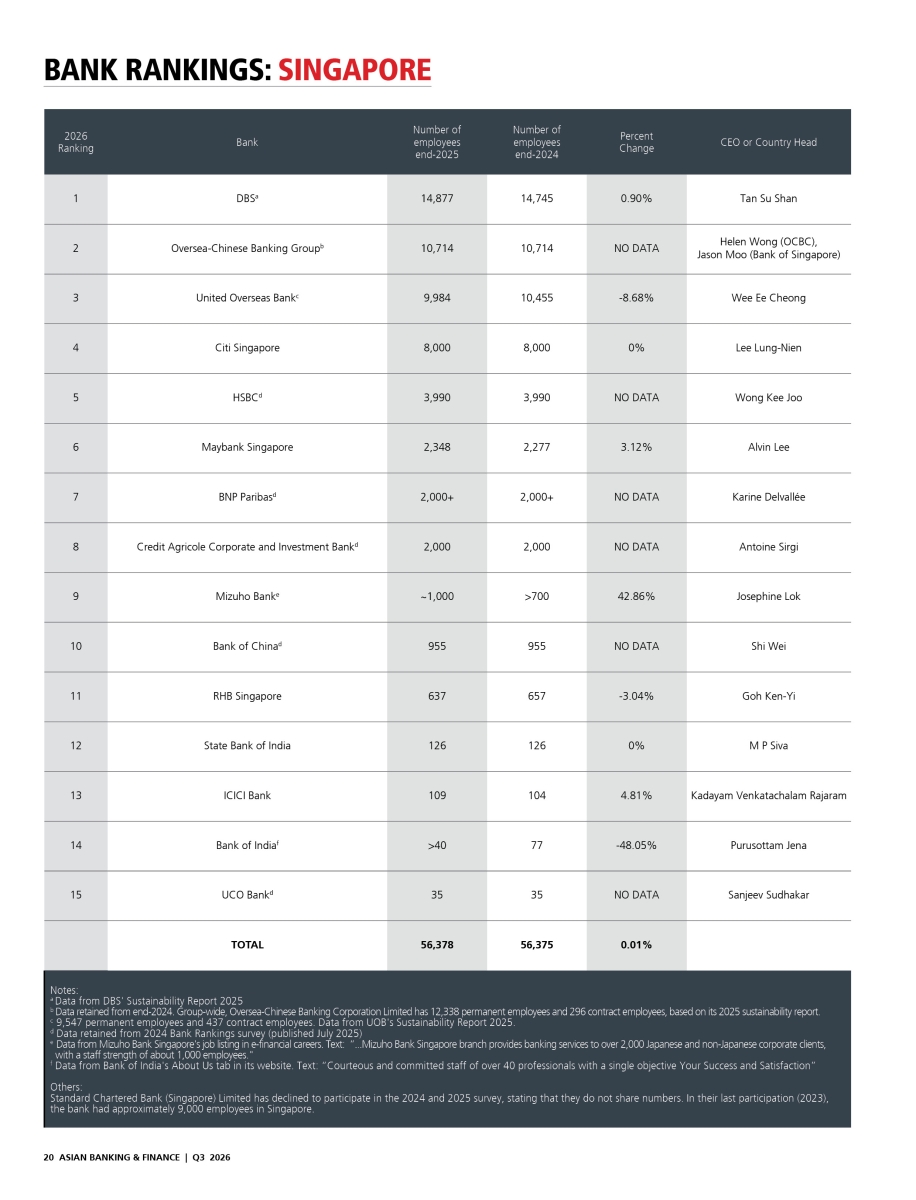
DBS Bank Ltd. remained the biggest employer among Singapore banks, increasing its headcount by 0.9% to 14,877 employees at the end of 2025 from a year earlier, according to its sustainability report.
In a 19 May statement, DBS said it plans to hire more than 500 young local talents this year through its management associate, internship, and traineeship programmes.
The bank expects to recruit 112 management associates, double its average annual intake over the previous two years, alongside more than 400 interns.
The hiring push at DBS contrasts with the broader caution in the sector, suggesting selective expansion in early-career pipelines even as senior hiring becomes more restrictive and multi-layered.
Oversea-Chinese Banking Corp. Ltd. (OCBC) remained the second-biggest lender by workforce size, with 12,338 permanent employees across its banking, insurance, and wealth businesses, including Great Eastern Holdings Ltd. and Bank of Singapore Ltd.
United Overseas Bank Ltd. (UOB) ranked third, with 9,547 permanent employees at end-2025, down 4.48% from a year earlier.
Recruiters said hiring demand is increasingly concentrated in AI, data analytics, and governance roles, particularly as regulators intensify scrutiny of technology use in financial services.
Ken Ong, managing director at Morgan McKinley, said demand for AI governance professionals is rising as banks expand use of machine learning and generative systems across operations.
‘Soft skills’
The Monetary Authority of Singapore proposed AI risk management guidelines in November 2025 and introduced an AI risk management toolkit in March. The toolkit, developed with 24 banks, insurers, and industry players, sets out frameworks to manage risks from traditional AI, generative AI, and agentic AI systems.
Recruiters said this regulatory push is reshaping hiring priorities, with banks increasingly seeking candidates who can bridge compliance, risk management, and technology deployment.
Lester Qin, managing director at Ambition Singapore, said employers are prioritising adaptability and cross-functional capability alongside technical expertise.
“They hugely emphasize soft skill nowadays, your adaptability, your growth mentality, rather than purely technical experience itself, because positions nowadays are very hybrid and very dynamic,” he said in a Microsoft Teams interview.
Ridza said banks want “hybrid banking talent” or professionals who can combine traditional banking knowledge with data, automation, and digital transformation capability.
At the same time, entry-level hiring is becoming more competitive. Nette said graduates from local universities once had clearer pathways into major banks such as DBS, OCBC or Standard Chartered Plc, but those routes have narrowed as automation and AI reshape junior roles.
He said some operational and technology support functions previously based in Singapore are now being relocated to lower-cost markets.
Many technology operations and lower-level support roles that were previously based in Singapore have shifted to markets such as Malaysia, Nette said.
Recruiters said this reflects a broader regional restructuring, where Singapore is increasingly positioned as a strategic decision-making hub whilst execution-heavy functions are shifted offshore.
Ong said this model is becoming more common across financial services firms in Asia.
“Being a headquarters in financial services doesn't mean that everything has to be done locally,” he said. “Anything that is more operational—middle to back-office function—I believe offshoring will continue to happen in our neighboring countries.”
Despite cost discipline, recruiters said banks are not retreating from hiring altogether. Instead, they are extending timelines and tightening evaluation standards to ensure alignment across business strategy, compliance expectations, and technology requirements.
Qin said contract hiring has stabilised compared with last year but is increasingly concentrated in replacement roles, sabbatical coverage, and project-based needs rather than expansion hiring.
There’s been a decline in project-based contract roles, Ong said. “A lot of projects finished at the end of last year and at the start of this year.”
He added that some contract positions are being converted into permanent roles during probation periods as banks seek to retain talent after initial hiring.
Data from Singapore’s three biggest banks shows a steady decline in contract staff over the past two years. DBS reported 42 contract employees in 2025, down from 50 in 2024 and 57 in 2023. OCBC reduced contract staff to 296 from 332 and 437 over the same period, whilst UOB lowered its contract workforce to 437 from 460 and 506.
Recruiters said demand for developers and coders has flattened compared with earlier years as banks focus more on optimisation than expansion.
At the same time, compensation remains competitive for critical roles, particularly in AI, cybersecurity, and risk management, with banks still willing to pay above-market rates for high performers.
Flexible work arrangements remain a recruitment tool, particularly amongst digital banks and fintech firms competing for experienced professionals.
Candidates are increasingly weighing stability, career development, and training opportunities alongside salary when evaluating offers, reflecting a more cautious labour market environment, Ridza said.


















 Read Here
 Advertise
 Sign Up