QR Ph captures 55% as card payments lose ground: PayMongo
Interoperability lets merchants accept payments from banks and e wallets through one code.
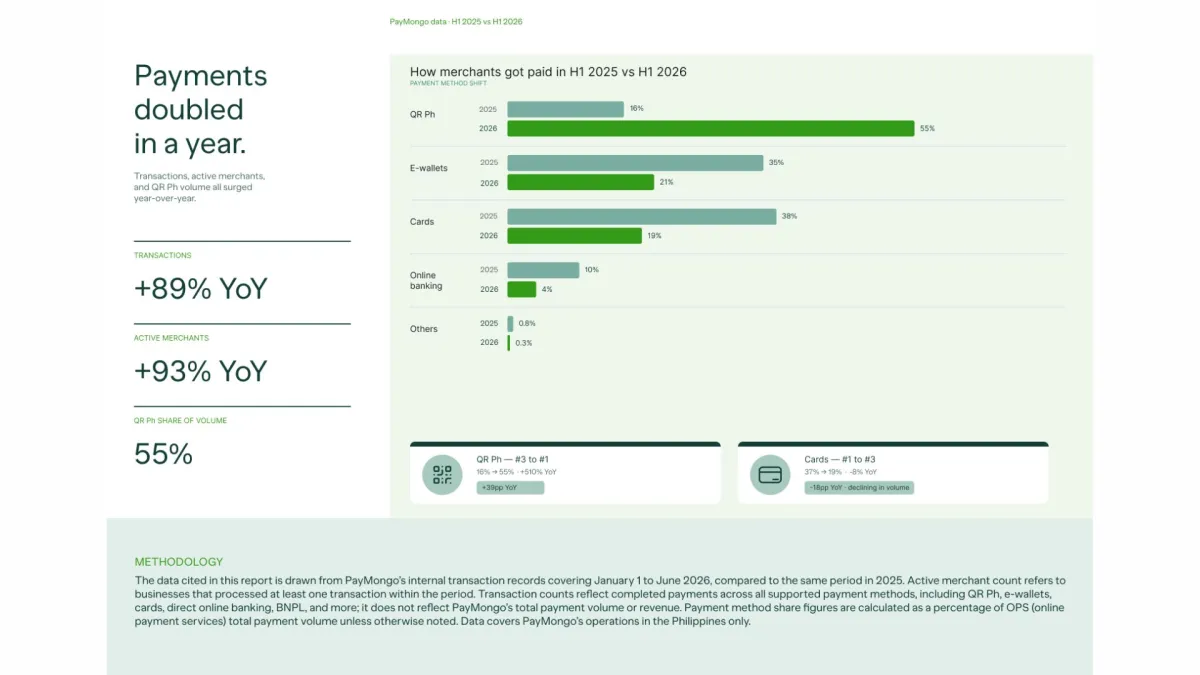
The Philippines’ national QR payment standard has become the dominant method for PayMongo's business merchants payments in the country, accounting for 55% share of the total payment volume in the first half of 2026 (H1 2026).
QR Ph volume surged by 510% year-on-year, overtaking both cards and e-wallets, according to financial technology firm PayMongo.
In the same period last year, QR Ph accounted for just 16% of payment volume, whilst card payments led at 38%.
That position has reversed, with card payment volume share dropping to 19%—an absolute volume decline of 8% year-on-year.
E-wallets now hold a 21% share, whilst direct online banking fell by 26% year-on-year to account for just 4% of the volume.
Other methods, including Buy Now Pay Later (BNPL), comprise less than 5%.
Despite the drop in overall volume share, cards remain the preferred choice for high-value transactions.
Whilst cards represent 19% of total value, they account for only 7% of total transaction numbers.
Conversely, QR Ph and e-wallets combined now make up 76% of total payment volume and account for nine in ten transactions, driven by everyday consumer purchases.
Mandated by the Central Bank of the Philippines, QR Ph allows merchants to accept payments from various participating banks and e-wallets through a single code.
According to the report, this interoperability has accelerated adoption amongst non-technical and small businesses.
In-store QR Ph transactions alone grew more than threefold year-on-year, whilst the company's no-code "PayMongo Pages" product facilitated nearly 1 billion pesos in payments for small enterprises.











 Read Here
 Advertise
 Sign Up